Handwriting
Pre-School and Nursery
In our Pre- School and Nursery, handwriting is nurtured through physical development, sensory exploration, and purposeful mark-making in line with the EYFS framework, rather than formal desk-based instruction. Practitioners prioritise gross and fine motor development—such as climbing, Dough Disco, threading, and outdoor large-scale painting—to build the core stability, shoulder strength, and pincer grip required before a child is physically ready to hold a pencil. Children are given daily opportunities to experiment with varied textures and mark-making tools to practise fundamental pre-writing shapes, lines, and circles, gradually progressing toward recognising and forming the letters in their own name. When appropriate, children begin to link early letter shapes to their phonics learning through the Read Write Inc. (RWI) programme, using the scheme’s visual picture cues and handwriting phrases to practise large-scale air-writing and sensory letter formation ready for Reception.
Reception to Year 2
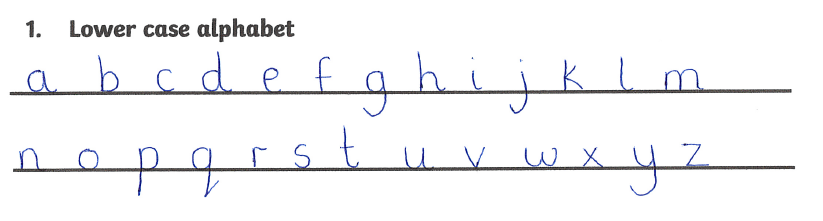
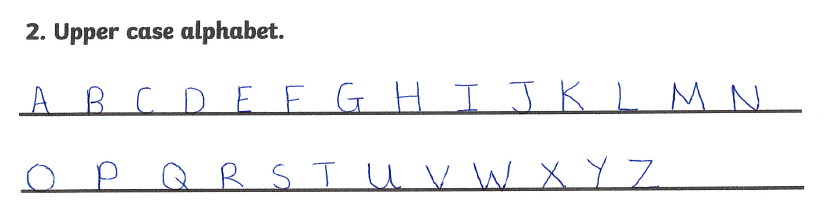
In Reception through to Year 2, formal handwriting instruction is delivered systematically through the Read Write Inc. (RWI) handwriting progression, ensuring consistency in posture, pencil grip, and letter formation. During Stage 1, children learn correct letter formation alongside their daily phonics lessons using the RWI mnemonics and picture phrases, grouping letters by shared formation patterns (such as 'around' letters, 'down' letters, 'curly' letters, and 'zig-zag' letters) while focusing on correct starting points and sitting letters neatly on the line. Once single letters are formed accurately and automatically, pupils progress to Stage 2, where they learn how to place letters in relation to one another with consistent sizing and spacing, preparing them for mature, joined handwriting as they move through Key Stage 1.
Year 2 (once ready) to Year 6
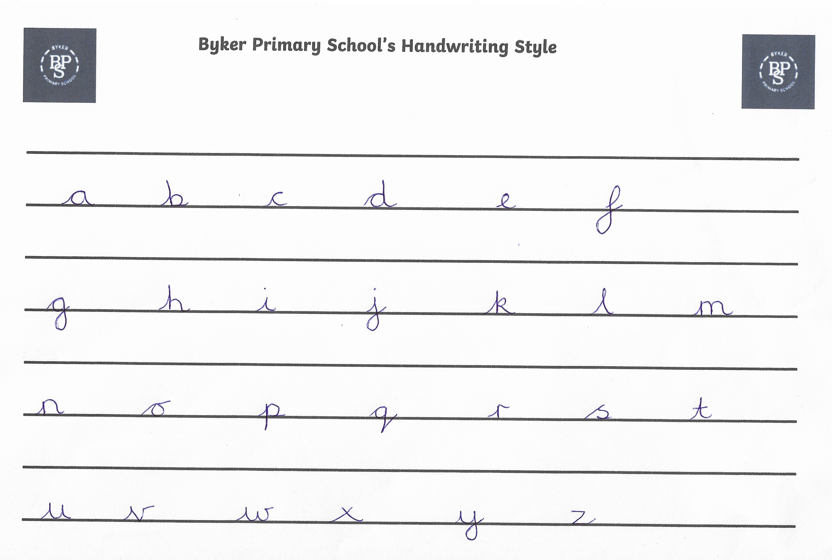
In Key Stage 2 (and for ready pupils in Year 2), children progress onto Stages 3 and 4 of the Read Write Inc. (RWI) handwriting scheme to develop a fluent, legible, and joined cursive style. During Stage 3, pupils are explicitly taught the two basic joins—the arm join (diagonal) and the washing line join (horizontal)—and learn which letters are best left unjoined (break letters) to maintain clarity and speed. To ensure continuity from Key Stage 1, children apply our school’s bespoke letter adaptations—including our adapted formation of the letter f, g, ’ and y alongside any other adjusted ascenders, descenders, or exit strokes—so that joins flow naturally. As pupils advance to Stage 4, the focus shifts toward building stamina, speed, and automaticity, enabling children to develop a neat, personal, and consistent joined handwriting style across all curriculum subjects.
Please see our handwriting style chosen for our school: